What the Latest DtC Beer Report Reveals About the Market

dtc-wine-report-2025

Overview

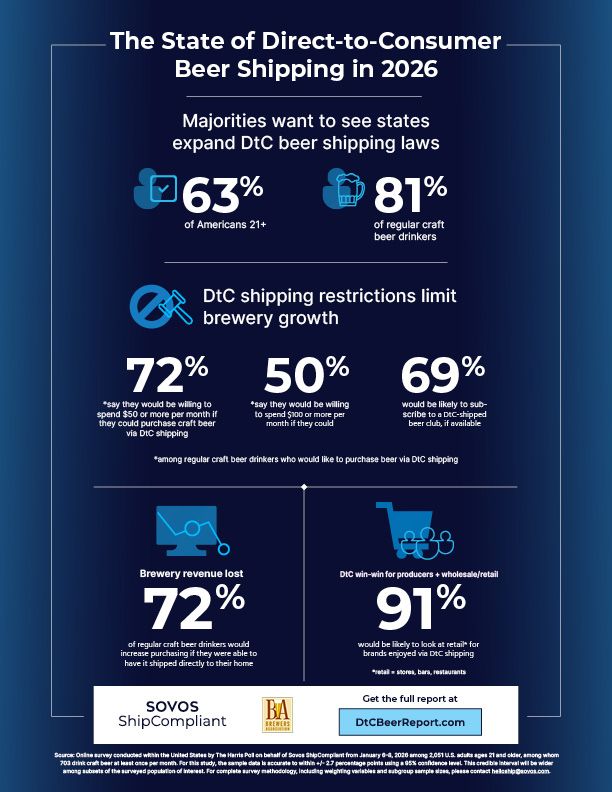
  • 63% of Americans aged 21+ — and 81% of regular craft beer drinkers — support expanding DtC beer shipping laws.
  • Breweries are leaving real money on the table: 72% of regular craft beer drinkers say they would increase their purchasing if they could have beer shipped directly to their home.
  • Consumer spending intent is high: on average, regular craft beer drinkers who want DtC shipping say they would spend $104 per month — roughly $1,249 annually — if they could.
  • The DtC beer market is still limited to 11 states plus D.C., while DtC wine shipping is permitted in 48 states and D.C.
  • 91% of regular craft beer drinkers who would purchase via DtC say they'd also seek out those brands at retail — meaning direct to consumer beer isn't just good for breweries; it's good for the broader three-tier system too.

Get Your Copy of the 2026 DtC Beer Report

Introduction

Now in its sixth year, the annual Direct-to-Consumer Beer Shipping Report — produced by Sovos ShipCompliant in partnership with the Brewers Association — tracks consumer enthusiasm and purchasing intent for beer shipping. The 2026 edition is based on a Harris Poll survey of 2,051 U.S. adults aged 21 and older, conducted in January 2026, including 703 regular craft beer drinkers.

The findings confirm what prior years have suggested: demand is strong, spending intent is high, and the gap between consumer appetite and legal access remains wide. As of March 2026, brewery direct to consumer shipping is legally permitted in just 11 states plus D.C. — compared to 48 states and D.C. for wine. That disconnect, and what it means for breweries, is what the report is built around.


Overview of the DtC Beer Market

The DtC beer industry operates within one of the most restrictive regulatory environments in the beverage alcohol space.

The states that allow DtC beer shipping — Alaska, Kentucky, Nebraska, New Hampshire, North Dakota, Ohio, Oregon, Vermont, and Virginia, along with D.C., and with limited parameters in Pennsylvania and Rhode Island — represent the full extent of the legal market for interstate brewery direct to consumer shipping.

That limited footprint exists not because of weak consumer demand, but because the regulatory framework hasn't caught up with it. The beer DtC market analysis in this report makes that gap plain: the appetite among American craft beer drinkers is broad, consistent, and increasingly well-documented. The question is when state legislatures will act on it.

The Current State of Direct-to-Consumer (DtC) Beer Shipping

Key Findings from the DtC Beer Shipping Report

The 2026 DtC beer report surfaces several findings that should matter to any brewery evaluating the direct-to-consumer channel — or any policymaker considering its future.

Demand has been consistent for four consecutive years. 78% of regular craft beer drinkers say they are likely to purchase craft beer via DtC shipping in the future — a figure that has held steady since 2023. Over a third (34%) say they are very likely to do so. This is not a passing trend in consumer purchasing behavior; it's a durable preference.

The spending potential is significant. Among regular craft beer drinkers who would like to purchase via DtC, 72% say they would spend $50 or more per month, and 50% say they would spend $100 or more. The average order value works out to approximately $104 per month, or around $1,249 annually — consistent with figures from 2025.

Restrictions are costing breweries revenue. 72% of regular craft beer drinkers say they would increase their purchasing if they could have direct to consumer beer shipped to their home. That's not hypothetical interest — that's stated intent from an engaged consumer base that currently has no legal path to act on it in most states.

The channel benefits the whole three-tier system. Ninety-one percent of regular craft beer drinkers who would be likely to purchase via DtC say they would also seek out those brands at a restaurant, bar, or retail store. DtC beer shipping isn't a threat to traditional retail — the data consistently shows it functions as a complement to it.

Public support for law reform is broad. Eighty-one percent of regular craft beer drinkers and 63% of all Americans aged 21+ support expanding DtC beer shipping laws. The regulatory impact on DtC beer is widely recognized as a barrier, and the push to change it has mainstream support.


Consumer Behavior in Direct-to-Consumer Beer Shipping

Because most states do not currently permit direct to consumer beer shipping, the data here reflects stated consumer preferences and intent from the 2026 survey. What stands out is how naturally beer fits as a shipped-to-home product in the minds of craft beer drinkers — they rank it nearly on par with food, cleaning products, and self-care items. 83% say DtC beer shipping would make them more likely to try beers from out-of-state breweries, and 75% have already felt the frustration of discovering a beer while traveling that they simply can't order at home.

The loyalty data reinforces the opportunity. Regular craft beer drinkers (69%) say they'd subscribe to a DtC-shipped beer club if one were available. 76% would purchase more frequently from a brewery offering DtC, 85% would recommend it to friends and family, and 71% would post about it on social media. What this provides for breweries is an established customer relationship channel that does more than just increase sales.


What the Direct-to-Consumer Beer Data Means for Breweries

The 2026 DtC beer report clearly makes the financial case for the channel, and the numbers speak for themselves. Of regular craft beer drinkers, 72% say they'd buy more if they could have beer shipped to their home, with an average order value of $104 per month among those interested. At the same time, traditional distribution is becoming harder to rely on, particularly for smaller producers. The report addresses both dynamics directly, along with what the data means for craft brewery performance across different market conditions.

For breweries already operating in permissive states, technology solutions that track regulatory changes in real time are essential to managing the compliance side of a DtC program efficiently. For those in states where the channel isn't yet open, the report provides the consumer data and legislative context needed to make the case for change. Download the full report for the complete picture.
Conclusion

The DtC beer market is still maturing, but the trajectory is clear: consumers want access to the beers they love, and breweries want direct relationships with the people who drink them. The challenge lies in navigating the regulatory and operational complexity that sits between those two goals.

The Direct-to-Consumer Beer Shipping Report exists to make that navigation easier. By grounding planning and strategy in real data — on beer DtC market analysis, craft brewery performance, regional beer trends, and consumer purchasing behavior — breweries can make decisions with more confidence and less guesswork.

Download the report to explore the full findings and see what the data reveals about the potential for the DtC beer industry.

FAQ

What trends does the DtC beer report highlight?

The 2026 Direct-to-Consumer Beer Shipping Report highlights sustained consumer demand for brewery direct to consumer shipping across four consecutive years, with 78% of regular craft beer drinkers saying they're likely to purchase via DtC in the future. The report also documents the significant spending potential in the channel — an average of $104 per month among interested consumers — alongside the regulatory impact on DtC beer shipping, which currently see limited legal access to 11 states plus D.C.

Why is direct-to-consumer beer shipping important for breweries?

Direct to consumer beer shipping gives breweries a path to market that doesn't depend on distributor relationships — increasingly important as wholesalers scale back on craft brewery performance tracking and prioritize high-velocity brands. The channel also drives loyalty: 76% of regular craft beer drinkers say they'd purchase more frequently from a brewery that offers DtC shipping, and 85% say they'd recommend it to friends and family.

How do regulations impact DtC-shipped beer sales?

The regulatory limitations on DtC beer are the central constraint on the channel's growth. As of March 2026, interstate DtC beer shipping is only legal in 11 states plus D.C., compared to 48 states and D.C. for wine. No new states expanded access in 2025, despite bills being introduced in Texas, Hawaii, and Illinois. The report notes that the model used by craft spirits producers — who secured DtC access in California effective 2026 — offers a potential blueprint for the DtC beer industry.

How does DtC beer shipping affect retail channels?

The DtC beer market data consistently shows that direct to consumer beer sales and retail sales are complementary, not competitive. 91% of regular craft beer drinkers who would be likely to purchase via DtC say they would seek out those brands at a restaurant, bar, or retail store. Rather than pulling consumers away from retail, DtC shipping introduces them to new brands they then go looking for in traditional channels.

Subscribe to our Newsletter

Get monthly updates on Sovos ShipCompliant resources, data reports, fresh resources and more.

Subscribe now